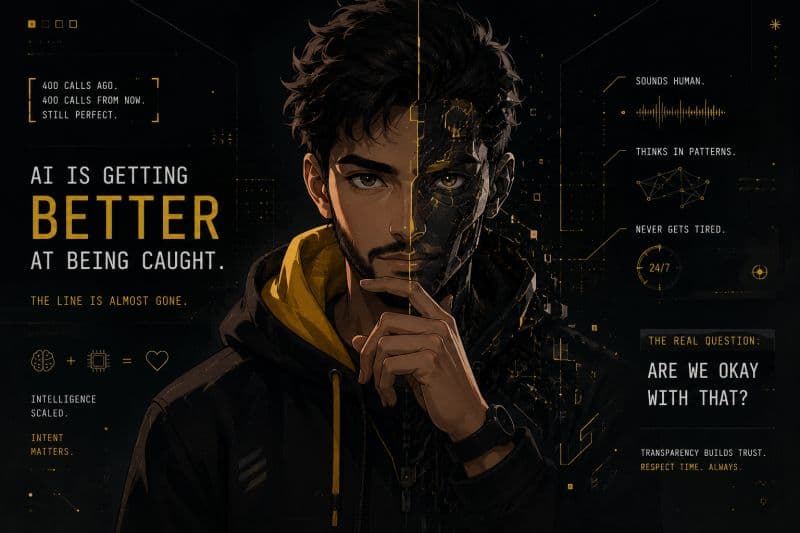
The Scariest AI Trend Isn't That AI Is Getting Smarter — It's That You Can't Tell Anymore
What happens when the voice on the other end of the phone sounds human, responds like a human, and handles every objection perfectly... but isn't human at all?
For years, spotting AI was easy. The robotic tone, awkward phrasing, and predictable responses gave it away instantly.
Not anymore.
Today's AI can write emails, make sales calls, answer customer questions, and hold conversations so naturally that most people never realize they're interacting with a machine. The real shift isn't that AI has become more intelligent—it's that AI has become invisible.
As the line between human and machine disappears, businesses face a critical question:
Do customers deserve to know when they're talking to AI?
And perhaps more importantly:
Do customers even care, as long as their problem gets solved quickly and efficiently?
In this article, we explore why AI detection is becoming nearly impossible, what it means for trust and transparency, and why the future may belong to companies that focus less on who is helping customers and more on how well they're being helped.
Why This Matters Right Now
In 2023, AI-generated content was often easy to spot. It sounded repetitive, lacked personality, and followed predictable patterns.
Fast forward to today, and AI can mimic human communication with remarkable accuracy. It adapts to context, remembers previous interactions, responds naturally, and maintains consistency at a scale no human team can match.
An AI agent can successfully handle hundreds of customer conversations in a single day while maintaining the same quality, tone, and patience throughout every interaction.
Humans can't do that.
The Disappearing Line Between Human and AI
The biggest shift isn't technical—it's psychological.
People are increasingly interacting with AI without realizing it. Whether it's customer support, sales outreach, appointment scheduling, or follow-up communication, AI is quietly becoming part of everyday business operations.
Soon, asking "Was that a human or AI?" may become as irrelevant as asking whether a website is hosted on a physical server or in the cloud.
The experience will matter more than the source.
Does Transparency Matter?
Many fear that customers will reject AI if they know it's not human.
The evidence suggests otherwise.
Most customers don't care whether the assistant helping them is human or AI. What they care about is:
- Getting accurate answers
- Solving problems quickly
- Avoiding long wait times
- Having a smooth experience
- Feeling respected
Transparency remains important because trust matters. But transparency alone isn't enough.
An openly disclosed AI that solves problems efficiently will often create a better customer experience than a human representative who is unavailable, unhelpful, or slow.
The Real Risk Isn't AI
The real risk isn't that AI sounds human.
The real risk is using AI poorly.
Customers become frustrated when AI wastes their time, provides incorrect information, creates unnecessary friction, or traps them in endless loops.
Bad experiences destroy trust regardless of whether the interaction involves a human or a machine.
Good experiences build trust regardless of who—or what—is delivering them.
The Future of Customer Interaction
We're entering an era where AI agents will handle a significant portion of business communication.
The companies that succeed won't be the ones hiding AI.
They'll be the ones using AI responsibly, transparently, and effectively.
The question is no longer:
"Can customers tell they're talking to AI?"
The question is:
"Did the interaction help them accomplish what they needed?"
Because when customers get fast, accurate, and helpful support, the technology behind the experience becomes secondary.
Final Thought
AI is no longer trying to sound human.
It already does.
The real debate isn't about whether AI can pass as a person.
It's about whether we're comfortable living in a world where the difference no longer matters.
And judging by the way customers already interact with modern AI systems, that future may have arrived sooner than anyone expected.
Comments
Loading comments...